THE PEEP TEMPEL
Updated: Nov 27, 2025
Writer: Keeley Thompson
Images: Suzanne Phoenix, Ian Laidlaw and Zo Damage

Carol’s moved inland now, renting a fibro house on the edge of town that’s still haunted by the scent of mozzie coils and degreaser. She works at the only pub, pours schooners for men who call her “love” and sometimes wonders if they half mean it. The town cop visits sometimes, but she reckons he’s shady. One of those guys that’s always smiling too big and is always too willing to help. God knows she’s got a pretty good radar for that shit now. Trevor’s gone, or maybe he isn’t - it depends who you ask. There’s a bloke from work who helps her fix the dishwasher and says he’ll take her fishing one day. Says he always catches the big fish. She smiles but doesn’t answer and keeps her heart locked up with her smokes in the storeroom.
Days are long. The two streetlights in town turn on at the same time as the cicadas. The buzzing of the two used to keep her awake at night.
Christmas is coming soon, but she’s never liked Christmas ham.
This is The Peep Tempel.
Sharp, sardonic, and caked in suburban dust, their songs swing between pub talk and poetry - tales that’ll make you laugh before they swiftly punch you in the gut. With snarling vocals and tense guitars, they turn the grind of daily life into something loud and alive, finding a kind of beauty in the heat, stink and chatter of an Australia that’s simultaneously tragic, charming and absurd. The Peep Tempel have got that larrikin streak and a way of turning the bloke next door into a myth and a legend: a drifter, a dreamer, a danger to himself and anyone within arm’s reach.
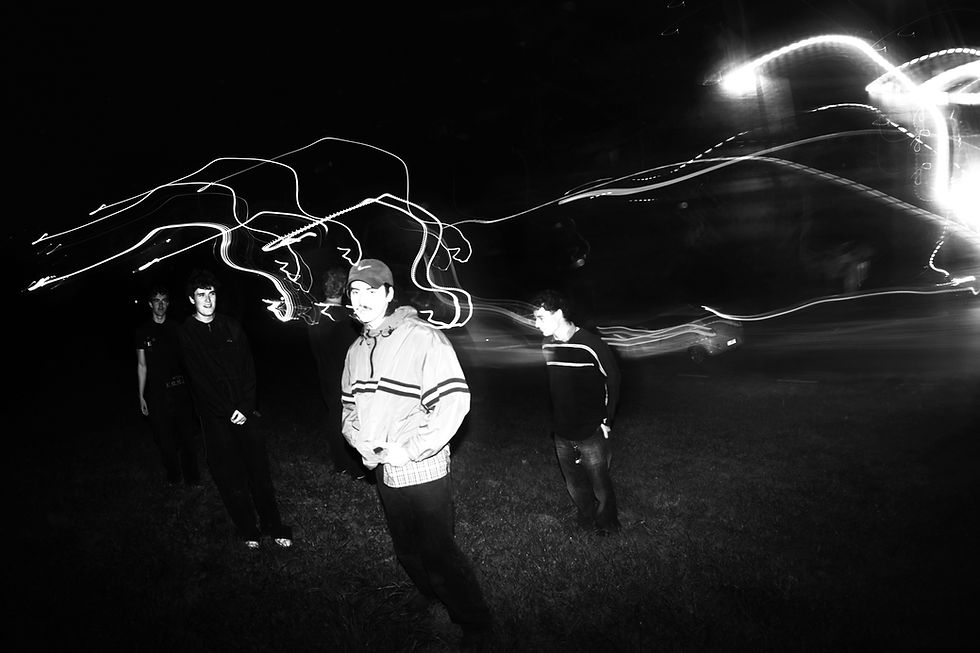
The Peep Tempel is Blake Scott, Steven Carter and Stewart Rayner. Together, they hammer out the soundtrack to the beautiful chaos that is often missed when you’ve got tunnel vision for the mundane. Sometimes it’s also just a laser-sharp observation on the normality of it all. It’s jagged, unpredictable, sweat-soaked rock that smells like durries, hot asphalt and kerosene.
KEELEY: How are you going?
BLAKE: Good. Adelaide went really well, it's great to be back playing shows over here. I didn't get much sleep last night though, I’m feeling pretty old. It's sort of hard to turn the buzz off, you know?
KEELEY: How are you feeling about tonight’s show in Brisbane?
BLAKE: I think it’ll be good - or at least I hope so! I mean, it's the old Zoo and it’s cool that the Crowbar crew were able to keep going.
I'm looking forward to it. I always like coming up here, to see some old friends, make some new ones, all that sort of stuff.
KEELEY: It’s been 11 years since Tales — how does that feel looking back now?
BLAKE: I've always had a sort of strange relationship with that record personally. I mean, it's the record that sort of changed our lives. With Carol being successful in its own little way it gave us the ability to tour and what allows us to do this tour now.
But yeah, it was a difficult record. It took us a really long time to get to, and it was a difficult time for the band. We weren't really sure if we were going to make anything else after the first album because that took a long time to come out so we were honestly pretty worn out already.
It just comes back to that simple fact that without Tales, we wouldn't still be doing it, not in this capacity anyway. That was the record that really put us on the map.
Eleven years is weird. It was meant to be ten last year, but it didn't work out.

KEELEY: Have your feelings towards those songs or the characters in them changed over time?
BLAKE: Not necessarily changed, but it is a little tricky at times. Probably not as much with Tales, but definitely some of the songs in the first record.
It feels like almost a lifetime ago. Because it is so character based, sometimes snapping into that fierceness can be hard - returning to that, I don't know if aggression is the word, but the intensity can be a little bit confronting.
It's interesting to go back to a part of yourself. There’s been a few times this year when I’ve been playing and thought to myself “who is this guy?”.
I've just had to sit with it a bit and just remember that, it's okay to change. My life has changed so much from the creation of those songs, but it's also been good to go back and remember.
So yeah, to answer your question, maybe it’s not that my feelings towards the songs have changed, but that I have.
KEELEY: Are the characters in your songs entirely fiction, or were they born from reality?
BLAKE: Observation. There's bits and pieces of real stories, the stories I've heard of other people and then just overhearing conversations in pubs and stuff all that.
I've spent a lot of time in the pub in my life from a very young age, so a lot of the characters started as something I’d heard or seen and kind of evolved over time. I suppose in a way they document a time too.
KEELEY: You’ve said before the lyrics reflected the world around you — how do you think those words hold up in today’s world?
BLAKE: Well, they probably never really held up anyway. You know, a lot of it's a little off centre and the characters are removed from society a little bit - outsiders.
Lately I’ve been thinking a lot about how we spend so much of our life masking - and I do especially. There's not too many situations I can't survive in, but I wouldn't say I thrive in them. So I guess with these records, I can create these environments for these people to be themselves and to tell their story. For me, by extension, I guess this is the purest form of me. It's not so much that I take on a character in a song or anything, but just the actual delivery of music. I think that is the purest form of my personality and who I am, so it gives me the opportunity to do that.
KEELEY: Yeah I wanted to ask actually - A lot of music tends to look inward, but yours often feels outward-looking. Why do you think that is? Did “anonymity" give you more freedom?
BLAKE: A little bit. I mean, there is a lot of me in those songs. Sometimes you realise later, but I think you always end up in the story in some way too.
I would say that I'm very emotionally connected to the writing, but I don't always know what it is, or how I’m connected to it. It's a very sort of stream of consciousness thing.
Doing stuff like this and getting asked these questions gives a chance to reflect and go “oh, hang on, maybe there is something to that”.
When we wrote Carol there was a lot of difficulty in the band where I sort of felt like we were going through a divorce. So Carol is a bit of a reflection of what we were going through as a band at the time.

KEELEY: I’d heard there was some almost Fleetwood Mac–style tension around writing ‘Carol’. How does it feel singing it now, knowing what was going on then, especially with it becoming such an anthem?
BLAKEL Well, honestly, I don't think about it. I mean, because I wouldn't say that that's the only sort of theme, but I think that was certainly a part of it. I also think it’s because that tension has very much healed now, we’re able to just enjoy Carol for what it is.
There was a time where it felt like it was going to get out of control with some people sort of misinterpreting the song and taking on that sort of really misogynistic view of Carol the character. We sorted that out very quickly though.
It’s lucky that Carol became an anthem, because we all love that song, and we all love playing it - which is a real commodity in the music world sometimes.
KEELEY: On the topic of Carol. What does it mean to be a Christmas Ham?
BLAKE: I've got no idea. But, if I do say so myself, it's a pretty good line.
I remember when we first played it, the song's composition came together in a take and I was just spitting out lyrics. When we finished Stu goes, "Did you just say I don't want to be a Christmas ham?" And I was like, "Yeah, I think I did."
It's probably the lyric that I can't explain, has the least meaning, but is probably the most effective of anything I've ever written, so there you go.
KEELEY: Probably selfishly, but I want to talk about Constable. It's tonally so different from your other songs, why do you think that is?
BLAKE: I just think the band was moving in that sort of direction. For the first two records, we’d been aiming for everything to sound like it was about to derail, but for the third record we just wanted something with a bit of flow and space.
We were spending a lot of time driving between Melbourne and Adelaide and the idea kind of just popped up. Steve and I landed on the drums shortly after I’d come up with the lyrics, and after that it was just about ensuring we left that space for the story.
We got lucky that I had that van, the 1991 Mitsubishi Express. That engine in the background was just perfect for that song.
KEELEY: Much like the kind-of protagonist from Constable, a lot of your characters seem troubled but still deeply human. How intentional was that balance of light and dark?
BLAKE: Not so much intentional, but I'm pretty to empathetic crooks. Not so much to corrupt police. But, I guess I understand how and why people get driven to that life.
It's my particular opinion, that if you're a police officer, you should not be corrupt. I've got some issues with the way in which the police force operates, so I've always done whatever I can to have a bit of a crack at them.
There’s also that line “at least I own my house” that while at the time was reference to an almost unattainable situation. But now that “Aussie dream” is completely out of reach for a generation and it's cruel. It’s just shows that if you’ve got people in positions of power justifying their actions with home ownership, it’s no wonder the rest of us are fucking fed up.
KEELEY: Constable actually inspired Radium Dolls for their track “Tractor Parts” — how does it feel hearing that ripple effect on other bands?
BLAKE: It’s really amazing, and there's a lot of responsibility with it for us as to how we show appreciation. We’ve had some really beautiful things during our time. We've even had a high school band perform Carol at their swimming carnival.
You never think about that stuff when you start. When we were talking about doing the show, Matt (who was originally our player and is now our guitar tech) mentioned that there's a generation who never got to see Peep Tempel. I’d never thought about it like that, but it was really eye opening for me.
We're really, really lucky that we’ve been able to make an influence on younger artists or any artist. To feel that you are contributing positively to something that is hard to keep breath in is an incredible feeling.

KEELEY: We’re at the unrelated questions segment now! I've heard that you're a bit of an electronic music fan, if you were playing a DJ set, what songs would you put on your USB?
BLAKE: Ah, I don't know. I've been getting right into Vanessa Worm lately. She's amazing. Probably some Throbbing Gristle and VACUUM.
KEELEY: Finally, what’s the best biscuit in the Arnotts assorted creams packet?
BLAKE: Oh, the Kingston. It's the greatest biscuit.
*Blake and I fist bump*
The Kingston's a pretty special biscuit. It's almost got a cooling effect that chocolate. Like there’s just a hint of mint or something in there. They pack a lot of punch for a tiny biscuit.
FIND THE PEEP TEMPEL:


Comments