THE WORLD IS AGAINST YOU
Words / Interview: Joseph Maranta
Images: Evie Thompson | @eviethomson._
I’ve always approached crying with the same trepidation I give to throwing up.
The same way I ignore nausea until my stomach forces me to keel over a toilet, is how I fight in vain to maintain a self-indulgent facade of stoicism until the tears can no longer be swallowed.
And yet, once I’m in the throes of sickness or emotion, I can’t help but appreciate the mental serenity. Despite the adrenaline coursing through my veins or the disgusting burn of gastric acid lacing my oesophagus, there’s at least no reasoning or dramatising taking place in my mind.
In a world that has commodified attention, true immersion has become ever more elusive. So much so that I’ve come to appreciate my body shutting down, for nothing else than providing a reprieve from constant stimuli.
As short-form content and advertising become more pervasive, I’ve found that albums are one of my final bastions of immersion.
Great, cohesive albums, or bodies of work, will always find a way to detach me from my surroundings. After enough listens, opening riffs will no longer remind me of their song titles, but instead the emotions I’ve applied to them. Each track becomes a world in its own right with each revisit further cementing its unique importance.
I was lucky enough to find a new vessel for immersion earlier this year when I was sent the demo of the debut album from Wellington-based quintet, The world is against you.
Patron Saint immediately floored me with its composition. Even on my 30th listen, I still find it’s closing track comes too soon. I doubt I’ll ever expect the album to finish, despite how many times I revisit it. I’ll always be wanting and anticipating another wash of emo-inspired shoegaze noise to start and enamour me for a further three minutes.
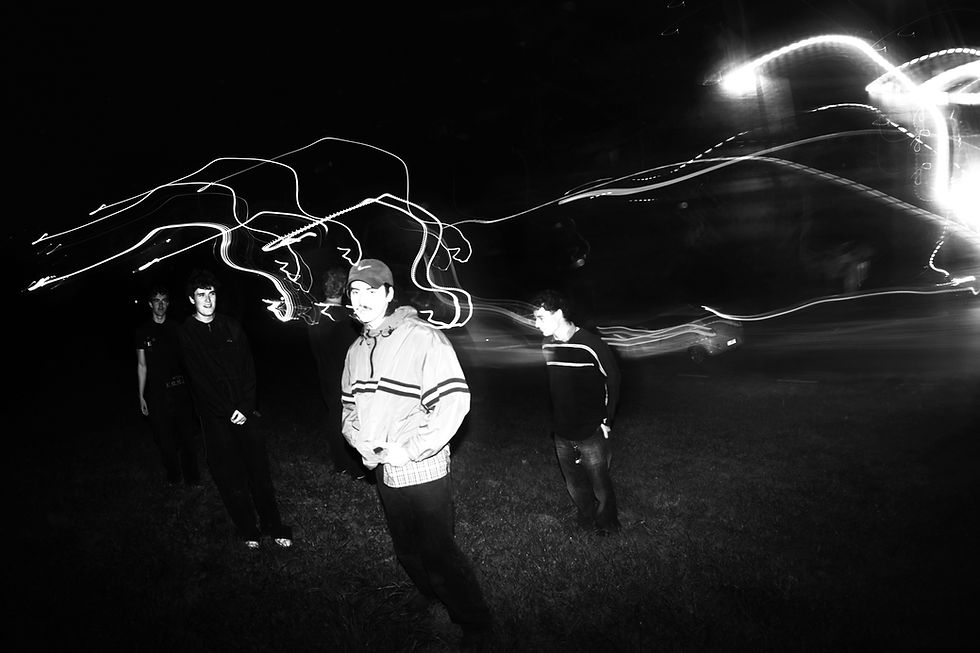
Unyielding in the curation of atmosphere, it’s equal parts gritty as it is vulnerable. Immersive in every sense of the word, Thomas Waddington (lead writer, producer, vocalist and guitarist), alongside his bandmates Ezra Beckett (drummer), David Hurnan (additonal guitarist), Stefan Jenkins (co-producer, guitarist), and Rhys Hicks (bassist) have carved out a lush world of their own making with Patron Saint.
Here’s our chat with Tom about his band, and their debut album.
JOE: Thanks for catching up Tom! You’re deeply involved in the Wellington music scene currently, so what can you tell us about the current artistic makeup of the city?
TOM:I think there’s been a shift in the culture, especially in the D.I.Y. scene here. In Wellington, and in the rest of the country, the main sound for a long time was that type of Mako Road, Ocean Alley and Sticky Fingers - sort of backyard barbeque reggae type of music. I’m not sure what’s happened, but as Millennials have aged out of the scene and been replaced by Gen Z, the scene in Wellington has become very noise rock heavy. Almost as if we’ve taken a step back, and we’ve become the Dunedin sound. It’s become a very tight-knit community of bands who make emo-adjacent music here. At least from my perspective, that’s the Wellington sound right now, very noise-heavy guitar music.
JOE: What do you think spurred that progression towards a heavier sound?
TOM: I can’t speak for everyone, but I think the sound here is imported from American shoegaze, specifically the Philadelphia scene, bands like They Are Gutting a Body of Water or Her New Knife. You’re seeing a lot of sus2 and add9 chords being played, and that is somewhat quite reflective of the idea of bands wanting to get out of New Zealand.
I was told this by a lecturer at University, they said,
“If you’re popular in New Zealand and succeed in the festival circuit you’ll do well in New Zealand, but if you’re not popular in New Zealand you’ll likely do well overseas.”
I think that’s indicative of why we’re seeing a shift from that typical New Zealand reggae sound, towards a darker wave of emo, shoegaze and post-punk.
JOE: You released your debut project, ‘Pat on the back’, almost a year ago. How do you reflect on the band’s first venture into recording a project?
TOM: That shit’s ass.
Nah, our last project was fun, but it’s commonly agreed between us that it’s not our favourite. The releases on that project are definitely serious, but it's very different to what our upcoming music sounds like. I still appreciate those songs, but they don’t feel very cohesive together, whereas our new album Patron Saint is far more of a thought-through sound as well as more thought through in its composition.
We really did not plan on taking this project seriously initially, it was just something for fun - something to screw around with. I was more focused on my label Glasshead Records last year, and I was treating T.W.I.A.Y. as a fun side project.
JOE: One of my main takeaways from Patron Saint was the fearlessness of its production, especially compared to ‘Pat on the back’. Were you eager to push yourself as far as you could creatively on this project?
TOM: Yeah pretty much.
The production, and sound on the record is meant to shift from the opening tracks until Horse. Very serious, post-punk introduction - and then the second half following the interlude we wanted to be more experimental and ballad-y. Regarding the production, our main influences were definitely Julie, T.A.G.A.B.O.W and Her New Knife throughout the album. Those bands are somewhat different sonically, and I wanted to curate a sound that was still between all of them.
I think Starthrower is the most reflective track when it comes to the influences behind the album.
There’s also songs like Miracle Cut which were a fully collaborative effort between Stefan, Ezra, Rhys and myself. It was inspired by us trying to avoid writing songs in 4/4 and a standard BPM, instead trying to have a more ballad type song. I think it's my favourite song off the album.
JOE: You frequently use distortion throughout the album, which makes your voice and lyrics quite unintelligible at times during verses and monologues. Does that shield of distortion give you freedom to write more vulnerably?
TOM: It definitely does allow me to be more vulnerable.
Ezra tapped me into writing in spoken word, since this album is more emo adjacent.
On the song Horse I do a spoken word poem, and although I do like the lyrics, it feels like it’s something written by Dax…
I hope other people don’t perceive it that way, but regardless I still buried that poem under the distortion so it’s less intelligible.
JOE: Why do you think inspiration wise you’re drawn to emo-adjacent genres?
TOM: I really, really love being in my room and turning my amplifier to ten. I could write the shittest song that objectively sucks, but if the amp is turned to ten and I can feel myself going deaf - then I’ll still get a strong feeling of euphoria regardless.
Going to local shows and seeing a band like King Hit playing, they play extremely loud music and despite how high quality their writing is, I’ll often find myself immersed less in their musicality and more in the atmosphere that live music creates.
Visuals inspire me a lot as well. Currently my main inspiration is Dirty Harry, but I found them through @digicamvids and @maddy.strydom, the visuals she’s done for them is amazing. The inspiration for Miracle Cut actually came through scrolling on @digicamvids. Really a lot of the album is inspired through her videography work and what she did with Dirty Harry and other bands.
Now that we’re preparing to do videos for our music, we’re looking a lot more towards her and her work for inspiration. I literally walked around town where my flat is recording with my laptop webcam to get that digicam look.
I’d really say inspiration wise I’d rank videography first, then culture second and then music itself third. When I’m writing, I feel as if I’ll end up ripping off a song or album if I’m listening to it while writing. I think that’s one of the hardest parts for me about writing music is not listening to music while I’m writing. So I try to substitute it with visual and cultural aesthetics.
JOE: On a scale of 1 to 10 how keen are you to play the Sore Horse festival later this month?
TOM: Eleven out of ten.
When Benji from Sore Horse reached out to us I couldn’t believe it, I thought he was fucking with me.
We’re genuinely so, so excited to be playing alongside some of the bands on that lineup, and to play to a new audience while supporting such a tight-knit community, I’m just so hyped.
What Benji’s built with Sore Horse in Australia, is exactly what I want to happen here in New Zealand.

JOE: Is Sore Horse similar to what you’d like to build with your own D.I.Y. label, Glasshead Records?
TOM: Pretty much!
I didn’t know about Sore Horse when we started Glasshead, but having talked to Benji, it seems like we’re both trying to create a community where bands have equal opportunities to break through, release music, and to run shows.
Especially here in New Zealand, musicians / bands can create tight circles which can become quite exclusive in terms of who other bands can play with. So the whole idea of Glasshead is to allow the local scene to break through more, while connecting bands with other bands throughout the country.
JOE: Do you think the Australian and New Zealand music scene should have more connection?
TOM: I think the reason why they aren’t connected is because the scene here is pretty fucked when it comes to local music. Our funding for the music and arts is abysmal, there really needs to be government reform and mandates for our local radios to actually play music from our country.
That being said, it’s really easy to say New Zealand sucks, but instead of being nihilistic about the situation, it’s good to look at collectives like Misheard in Auckland, and Glasshead in Wellington I guess, who are initiating a community in the underground. It gives me hope that there will be change in our live music scene through the grind of community.


Comments