KURRALTA PARK
Updated: May 19
Interview & Words: Joseph Maranta
Photos: Tom Redden @daybed_drive

I interviewed a Newcastle band called Trophy Wyfe last year, and the frontman, Rex, expressed his adoration for bands such as Floodlights and Radium Dolls, like many other artists I’ve spoken to have, but his explanation always stuck with me.
“Floodlights and Radium Dolls: There’s something about those bands where you can tell they’re Australian even before they start singing.”
Since that interview I’ve listened to Australian musicians slightly differently, especially those who often get tagged with the title of Australiana, and the idiosyncrasies of some of my favourite musicians have become far clearer.
Bindi of Kurralta Park will discuss his own thoughts on the matter later in this article, but to me artists like Powderfinger, Ruby Fields, dave the band and Courtney Barnett (to name a few of my own favourites), have always given me a feeling of deep familial comfort through their own interpretations of Australiana. They all exist in different genres, be it in categories or subcategories, but that warm haven of explicitly Australian music offers me refuge all the same. Despite the excellence of so many Australian bands, there’s a specific goosebump-inducing pride I find myself overcome with when I blare Thrilloilogy, Dingo, Fine!, or Nameless, Faceless respectively, that can only be found in musicians who wholeheartedly embrace the influences and perspectives which have moulded Australian music into what it is today.
As it pertains to Kurralta Park, the trio epitomise everything I love about Australian music and have rapidly become one of my favourite Australian bands to date through their pedal-happy guitar riffs, wholly vulnerable perspectives, and unyielding energy.
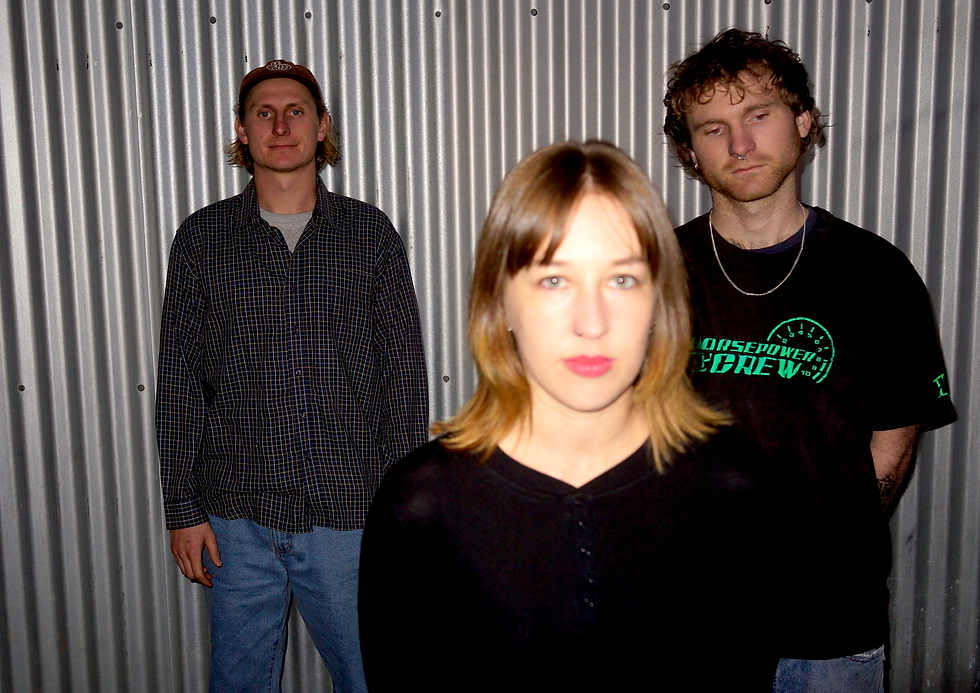
Self-described as a bruising vehicle of disaffected Australiana aggression, the three-piece hails from Adelaide and is fronted by vocalist / guitarist Bindi McCallum, supported by bassist Madelaine Zammit and drummer Zack Dowd.
They're one-of-a-kind, but cut from the same cloth as the revered Australiana acts before them.
Here’s our chat with Bindi McCallum of Kurralta Park.
JOE: Bindi! So awesome to speak with you finally. How’s life been recently, what have you been up to?
BINDI: Life’s been good!
Ridiculously busy though. I got diagnosed with ADHD today, you’re the first person I’ve told actually, it’s hot off the press.
JOE: Woah that’s big news. Are you worried about losing any of your creativity if you take medication for it?
BINDI: I asked my psychiatrist if I was going to lose my ‘edge’. But they said that the medication doesn’t take away the creativity, it just helps me do the jobs I’m not interested in, like the admin side of this music shit. So I’ll be better at prioritising and organising things, which is good because I’m fuckin’ useless when it comes to that side of it.
But I don’t know, I’ll play it by ear and if being on meth doesn’t serve me well then I’ll stop taking whatever it is and find another solution.
JOE: Taking it back to the start, you grew up in a very isolated part of the world out in rural South Australia. How do you think growing up in a place like Melrose affected you and your relationship with music and the arts?
BINDI: Initially I was pretty dark on it all. Once I moved to Adelaide I felt like the city kids grew up with those creative influences around them, and that it was something I’d missed out on growing up.
But in hindsight, I really appreciate that I had a different childhood to most, because it gives me something different to talk about. I realised that I have a unique perspective on my experiences compared to people who’ve grown up in metro areas.
JOE: Was the isolation something you were cognisant of growing up?
BINDI: I played a lot of junior representative sport so I was travelling around cities and towns pretty often as a kid, and that gave me a good understanding as to what was going on. But I didn’t feel too affected by it then.
It wasn’t until I started spending a lot of time on the internet, specifically tumblr, when I began to question my place in the world. I’d been writing songs since I was a teenager, which served as an outlet for those strong feelings. But it was a strange thing for me to do in a country town, there weren't a lot of expressions of that form in Melrose when I was growing up.
JOE: Growing up did you want to be a footy star or a rockstar?
BINDI: When I was a kid I wanted to play cricket for Australia. But then I worked out I don’t like running, and that’s when I realised sport wouldn’t be my end all. Towards my later teens I had a vision of where I thought I’d end up, and that was playing covers in the corner of a shitty pub, and I was stoked with that.
JOE: How did you pivot from being a Soundcloud rapper as a kid into the grunge / alternative sound you play now?
BINDI: I was 15/16 years old when I started getting into the Australian scene through Drunk Mums, Skeggs & Dune Rats.
That’s when I understood where I wanted to end up in music. I always enjoyed playing guitar, but I’ve also always been pretty shit at it. When I was rapping or singing without a guitar, I could at least fumble my way through that. Probably only once I’d moved to Adelaide did I actually ‘pivot.’ I was hanging out with guys that were a bit older than me who fostered that interest in guitar music.
JOE: When you eventually made the move to Adelaide, how were you initially interacting with the city’s scene?
BINDI: I wasn’t involved with the scene too much when I first moved here. When country kids move to Adelaide, they often move into a residence first where they’ll stay while at university. So I met some guys from Mount Gambier and Port Lincoln and we started a band while we were all living together.
I really didn’t know anything about what was going on in Adelaide at the time, I just knew the bands my friends were in and that was the extent of things. I didn’t have a proper gauge of the scene until maybe five years ago.
JOE: So when did Kurralta Park come into the picture?
BINDI: Kurralta Park is still relatively new, we’re only just coming up on three years of it.
Our drummer Zack plays in a band called Ethanol Blend and I was, and still am, obsessed with that band. Even when I was in the country, my Mum would drive me to the city to see their shows, and that drive from Melrose to Adelaide is three hours one way.
So I was always in love with them and I’d try to weasel my way into friendships with them and it never worked. But I had a big night with Zack a while ago, and we got on really well. He was a rockstar to me at the time and I couldn’t believe I was hanging out with him.
At the time Kurralta Park was still a solo project. But a week or two after that night out, one of our mutual friends said that Zack was keen to drum for me and turn the project into a live band, which I hadn’t even considered at that point. We met up and tried to play some songs but Zack didn’t bring a kick drum, or a snare, or a stool to sit on - he didn’t bring any of his shit.
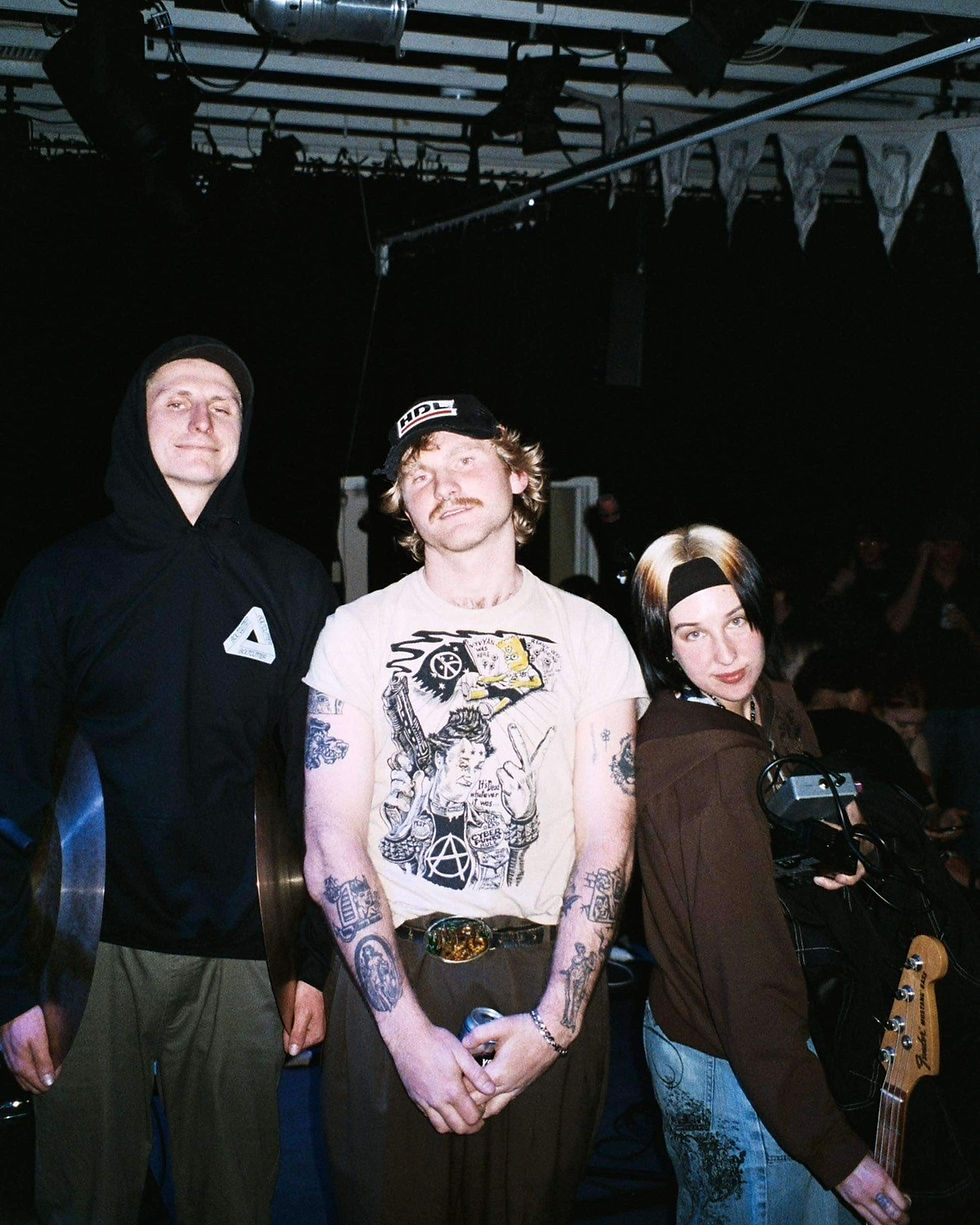
So we said fuck it and went for a skate, and that’s when he mentioned his friend Maddy who played bass and that’s how the three of us came together.
The whole point of the band was to have a project where we could hang out on the weekends, and music would be on the side. It was an excuse to hang out and have beers and ciggies while catching up as mates.
JOE: So was Zack your entry point into Daybed Records?
BINDI: Yeah he was, the lead singer of Ethanol Blend, Jack Stokes, is one of the two people from Daybed Records, and it was the same thing of me trying to weasel my way into a friendship with him and Tom because I respected what they were doing. They’ve built their own scene down here which is really cool.
Because Daybed have been in and around this scene for so long, they have a great understanding of how this world operates and the personal struggles that come with the band life.
So a lot of their help is giving me support, knowing the right things to say, as well as linking us up with all the right crew in the industry that they’ve met through their own paths.
JOE: You’re a self-described Australiana band, so what does that term mean to you and who do you point to as current Australiana acts and pioneers of the genre itself?
BINDI: Australiana to me is not hiding the accent and not dulling down the Australian perspective for the wider audience.
To me it’s recognising that where we are is a very isolated part of the world from external arts and culture. So being able to wear that on your sleeve, not in a weird nationalistic way, but in an honest, cool way is really important to me, even more so as a consumer.
Bands like The Pretty Littles, Mini Skirt, Good Boy, Peter Bibby and Stella Donnelly are acts I’d point to that really influenced me in that way. Australiana to me isn’t a sound necessarily, other than the accent, but it’s more the perspectives they bring.
JOE: Do you mind explaining the backstory of one of your tracks, ‘Rinsed With Doubt, Damp to Touch’?
BINDI: My friend Sam put on a festival with two stages, one upstairs and one downstairs. At that point in my journey as a musician, I didn’t know how to overcome feelings of anxiety and disappointment, as well as what to do when shit doesn’t go your way.
So at the start of my set there were maybe five people in front of us, and that just shook me. I had shaky hands and I couldn’t sing. It felt like I was out of breath. Within five minutes of us playing everyone had come upstairs and the venue was packed, but I was already rattled, I couldn’t pull myself out of it.
So that was the context of the song, just me being a sook and not having the tools to deal with it. But now I do. When I’m playing to cunts who don’t give a fuck, I love it. I’m here, I’ve got these songs that I’m feeling really hard and I don’t give a shit if you’re not getting into it. I’m almost looking for people who don’t care in the crowd because I’m just going to keep feeling myself right in front of them.
But I credit Jack from Daybed and Finn from Colourblind and Win Big for helping me get over those feelings and inhibitions.
JOE: The writing on your most recent album ‘Powell Place’ feels a lot more aggressive and poignant compared to ‘I Told My Boss I Was a Rockstar and Then He Fired Me’, so what contributed to that emotional shift between projects?
BINDI: There was a point when I became intensely passionate about music in between these projects. I began to feel emotions a lot more heavily. Maybe it’s the whole cringe tortured artist thing, but I was really sitting in my emotions and I couldn’t get over them until I’d written some rubbish in my notes app about them. Failed romances and working in fuckin’ construction definitely helped push me further into passion as well.
JOE: I have a hypothetical for you: It’s the day of your Foo Fighters show, and you receive a DM from Alex Neal-Bullen. He says that he’s seen your videos and he’ll use one of your tracks as his goal song, but he also tells you he has a vendetta against Dave Grohl. He says he’ll play ‘Into My Gums’ when he scores a goal, but only if you forgo the Foo Fighters show. What’s your next move?
BINDI: Okay. Well we have lots of mutual friends, so I’m getting his address and I’m picking him up in my HiAce and telling him ‘alright Nibs we’re getting an AirBnB together and we’re gonna bro out, fuck this gig bro. You and me we’re gonna hang out'.
From there I’ll drive him to Coopers Stadium, I’ll give him a guitar, we’ll get on stage and then from that night we’ll be best friends, he’ll love the Foo Fighters and he’ll love Dave Grohl. Then he’ll use My Hero as his goal song and still won’t play Kurralta Park.
JOE: So how did the Foo Fighters gig come about in the first place?
BINDI: I got an email from Bandcamp, which was hell random because I’ve never been contacted by Bandcamp’s internal messaging service before.
The message was regarding a show on a week night with a phone number to call. I was bored at work so I gave him a ring and it turned out to be the director of the touring company. It was a really random way to get the most hectic gig offer in the world.
But it’s really cool that Foo Fighters are rolling with a bunch of local bands all across Australia and New Zealand, I can’t remember seeing a tour where small bands have been given this much of a platform. It’s mental that they’ve done that. There will be so many fans at these shows who aren’t tapped in to Australian music at all, and we’re talking about shows that will have around 15-20k people in attendance who won’t have seen live Australian music in the last 10, 15, or 20 years.
JOE: Are you nervous at all to play such a big show in front of so many people?
BINDI: I’ve definitely got some mental work to do before then.
A Tasmanian band called Spooky Eyes played with Foo Fighters in Launceston in February and I saw on their Instagram reels a video of how many cunts were there in front of them. I genuinely felt my stomach drop watching that clip.
I’m definitely excited for it because I loved playing in Melbourne last month in front of a completely new crowd, it felt like a really nice challenge. So I imagine the Foo Fighters show will be that feeling on steroids.
But I think I’ll be okay.
JOE: You’ve said before that the first concert you ever went to was a Foo Fighters show in Adelaide back in 2016, so it’s clear you’re a big fan of them. But outside of the Foo Fighters, what other major band would you be most honoured to open for?
BINDI: I reckon Title Fight.
If they ever came back and did a reunion tour, that would be the most special for me.
JOE: Kurralta Park has gained a lot of momentum lately, but you still haven’t played a show outside of Adelaide or Melbourne. Why do you think that is?
BINDI: Because I’ve never toured before, it seemed too difficult, and I never anticipated that people would give enough of a fuck to come and see us outside of Adelaide.
I work in construction, Zack works in a winery and Maddy has been studying for the last three years. Those commitments and the work-life balance have prevented us from striving towards big tours in the past.

JOE: It’s been nine months since Powell Place and all the success and acclaim that came with it, so do you find yourself in a writing phase right now? Or are you basking in the good times?
BINDI: Nup, we aren’t taking things in, we aren’t allowed to take things in.
We’re spending a lot of time writing and also working in the studio at the moment. I’m mainly working on stuff with an acoustic guitar for now while writing in the notes app at work.
JOE: Since your songs are quite cathartic and draw from your own life experiences, do you find the lyrics gaining sentiment with each performance? Or has playing them dulled the punch those memories once had?
BINDI: I didn’t realise it until recently, but the live performances have become a massive healing for me. I hang on to feelings for too long hoping to make something out of them. Although it does help me to process what I was feeling, I do feel those things more now, and it’s good that I can let go of it on stage.
JOE: Just finally, in five years where do you hope Kurralta Park will be?
BINDI: I actually wrote out my five-year plan a few weeks ago. I sound delusional talking about it, but maybe you have to be.
I want people to be feeling this shit not only in Adelaide, South Australia, but all through the most random pockets of the world. I want to be able to play in different countries and have crew connect with it like they would in Adelaide.


Comments